Ashwin Kumar
PhD Candidate.
Stanford University.

I’m driven by the potential of artificial intelligence to transform disease diagnosis and prediction—enabling earlier, more accurate, and personalized care, especially for neurological disorders. I’m committed to building AI tools that bring greater objectivity and transparency to medicine.
I am a PhD candidate in Stanford’s Biomedical Physics program advised by Greg Zaharchuk and Akshay Chaudhari. My research focuses on developing artificial intelligence methods for medical image acquisition and analysis. In particular, I’m interested in multimodal representation learning for medical imaging. I am grateful to be supported by the Knight-Hennessy Fellowship and the Tau Beta Pi Fellowship.
Previously, I graduated from Vanderbilt University with a B.S. in Computer Science and Neuroscience and an M.S. in Computer Science. During my time there, I conducted research at several institutions, including Vanderbilt University under Bennett Landman (MASI Lab) and Seth Smith, Columbia University under Eduard Guo, and UT Southwestern with Frank Yu.
Beyond research, I led initiatives aimed at reducing educational inequality and making science and education more accessible and enriching. My academic and service efforts were recognized with several honors, including the Goldwater Scholarship, Vanderbilt Chancellor’s Scholarship, and Vanderbilt Top 10 Outstanding Senior.
recent highlights
| Mar 2026 | Merlin has been accepted to Nature and has already surpassed 100K downloads! |
|---|---|
| Feb 2026 | CheXmix has been accepted to CVPR Findings 2026! |
| Jul 2025 | MedVAE recieved the Best Oral Paper Award at MIDL and has exceeded over 40K downloads! |
| Apr 2025 | Presented our work on Merlin at the MedAI exchange (Youtube) and RSL Seminar. |
| Oct 2024 | Received the Outstanding Citizenship Award from Stanford RSL and the Best Poster Award at the Stanford AIMI Symposium. |
selected publications
- Vision-Language
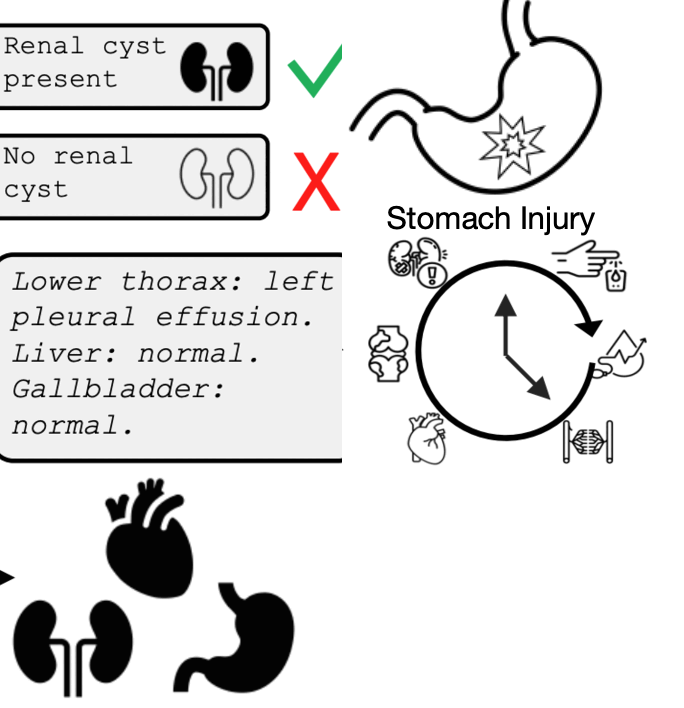
 CheXmix: Unified Generative Pretraining for Vision Language Models in Medical ImagingIEEE/CVF Conference on Computer Vision and Pattern Recognition (CVPR) Findings, 2026
 - Image Downsizing
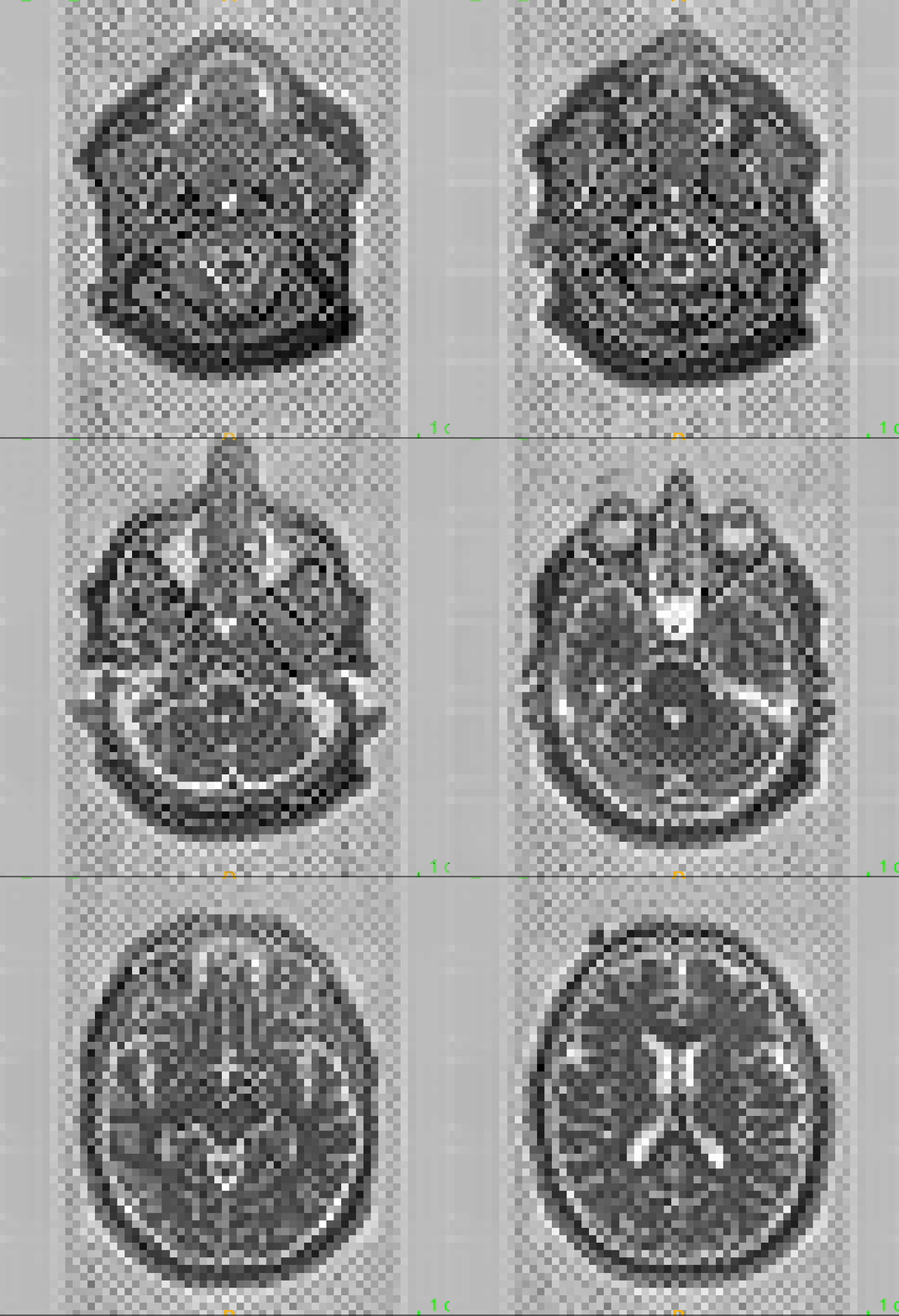 MedVAE: Efficient Automated Interpretation of Medical Images with Large-Scale Generalizable AutoencodersMIDL, 2025